The world was created by a big bang, but how do we know? There’s lots of evidence that tells us what, when and how it happened.
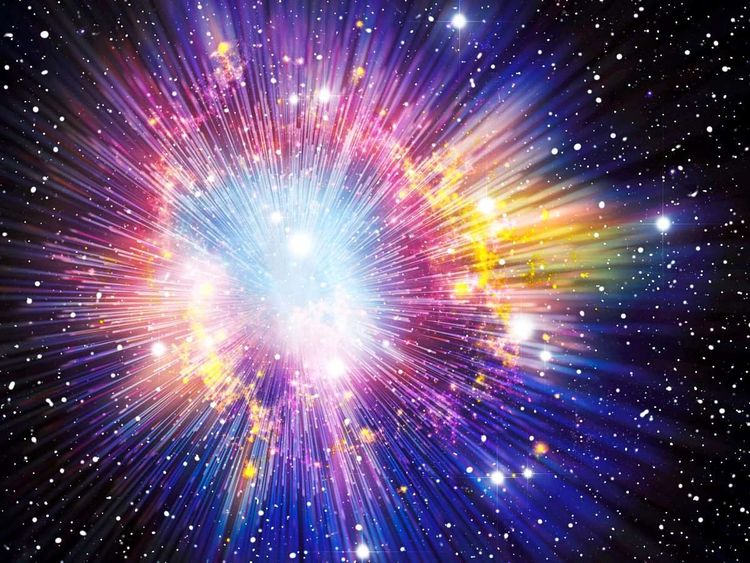
The big bang first occurred 13.8 billion years ago and it created STEM – Space, time, energy and matter. As well, it also created SWEG which are types of energy. They are Strong Nuclear, Weak Nuclear, Electromagnetism and Gravity.
At the time of the big bang the universe was hot and tightly packed. After the big bang the universe quickly began cooling and expanding. Within minutes, particles of matter formed atoms of hydrogen and helium. Those atoms later formed stars, which led to the creation of planets.
Scientists measured the amounts of helium and other chemical elements in the universe today. Those amounts match the numbers that the astronomers calculated should exist according to the big bang idea.
But how do we know this? There are two huge discoveries that’ve been made in science which strongly support the Big Bang Theory.
In 1924 a scientist called Edwin Hubble used a special technique to measure distances to remote objects in the sky and the speeds they were travelling. he discovered that the further away objects are from us, the faster they’re moving away from us. This is what we now call ‘Hubble’s Law’. This relationship between things was later used by Hubble as evidence that the universe is expanding.
Another scientist called Henrietta Leavitt made a discovery to help people understand how big the universe actually was. Her job was to look at special photos of stars, called photographic plates. She measured and listed how bright these stars were.
She discovered that certain stars have a link between their brightness and how long it takes for their light to change. They helped scientists measure the distance to faraway galaxies for the first time.
Then in 1960s scientists discovered cosmic microwave background radiation.
Robert Wilson and Arno Penzias. Robert Wilson is famous for helping to find the cosmic microwave background radiation (CMB) in 1964. This discovery was a big step in understanding how our universe began.
In 1964, Wilson and Penzias were working with a large antenna at Bell Labs. They were trying to improve satellite communications. Their goal was to remove all sources of unwanted radio signals, or “noise,” from their antenna.
What is that noise?
They kept hearing a faint, hiss or buzz coming from every direction in space. They tried everything to get rid of it even cleaning pigeon poo out of the antenna, thinking that was the cause! But the noise remained. It was a mystery.
This noise turned out to be cosmic microwave background radiation (CMB) which is radiation like an echo or leftover heat from the very early universe. Scientists had predicted that such radiation should exist if the universe started with a “Big Bang.”
The discovery says that the universe began from a very hot place and has been expanding ever since. The CMB is the oldest light we can see, showing us what the universe was like when it was only about 380,000 years old.
More evidence
Redshift is a way astronomers figure out how far away objects are in the Universe.
Astronomers can tell how much light has shifted because every chemical element, like hydrogen or oxygen, has a special “fingerprint” of light. No two elements have the same one!
They use a tool called a spectroscope to look at the light from a distant object. This tool breaks the light into its different colors, showing these unique “fingerprints” as spectral lines.
By comparing where these lines are to where they should normally be, astronomers can tell if an object is moving towards us or away from us. They can also figure out how fast it’s going. The faster an object moves, the more its spectral lines shift from their normal spot.
Light from distant galaxies looks redshifted which means the light waves have been stretched to longer wavelengths and lower frequency as they travel.
 Sasha's science
Leave a comment